Abstract. Robots have gained relevance in society, increasingly performing critical tasks. Nonetheless, robot security is being underestimated. Robotics security is a complex landscape, which often requires a cross-disciplinary perspective to which classical security lags behind. To address this issue, we present the Robot Security Framework (RSF), a methodology to perform systematic security assessments in robots. We propose, adapt and develop specific terminology and provide guidelines to enable a holistic security assessment following four main layers (Physical, Network, Firmware and Application). We argue that modern robotics should regard as equally relevant internal and external communication security. Finally, we advocate against ”security by obscurity”. We conclude that the field of security in robotics deserves further research efforts.
Full text transcribed from the original publication source.
1 Introduction
Robots are going mainstream. From assistance and entertainment robots used in homes, to those working in assembly lines in industry and all the way to those deployed in medical and professional facilities. For many, robotics is called to be the next technological revolution. Yet, similar to what happened at the dawn of the computer or the mobile phone industries, there is evidence suggesting that security in robotics is being underestimated. Even though the first dead human from a robot happened back in 1979
Over the last 10 years, the domains of security and cybersecurity have been substantially democratized, attracting individuals to many sub-areas within security assessment. According to recent technical reports summarizing hacker activity per sector
In an attempt to provide a solution for the second problem, this paper presents the Robot Security Framework (RSF), a systematic methodology for performing security assessments in robotics. We argue that security, privacy and safety in robotic systems should clearly be recognized as a major issue in the field. Our framework proposes a standardized methodology to identify, classify and report vulnerabilities for robots within a formal operational protocol. Throughout the description of the RSF, we present exemplary scenarios where robots are subject to the security issues hereby exposed.
The sections below are organized as follows: Section 2 describes previous work in the field of security for robots. Section 3 elaborates upon the proposed framework. Finally, Section 4 draws major conclusions out of our work.
2 Previous work
Robot security is becoming a concern that extends rapidly. However, to date, and as already briefed in the Introduction section, there are few honest and laudable efforts that elaborate into methodologies for analyzing robot’s security or cybersecurity. The most relevant of those pioneering contributions is Shyvakov’s work
The author’s
In an attempt of providing real use-case scenarios, the author
Other contributions to robot security, have primarily focused upon providing only partial contributions, e.g. hardening particular aspects of robots, such as middleware
Recently, some pieces of research such as
Inspired by the current state of the art, inter alia
-
Reformulation of the categorization terms. In particular, the term component becomes aspect. Component is a rather generic term in robotics and it typically refers to a discrete and identifiable unit that may be combined with other parts to form a larger entity
. Components can be either software or hardware. Even a component that is mainly software or hardware can be referred to as a software or hardware component respectively. In order to avoid any confusions, rather than component, the term aspect will be used to categorize each layer within RSF. -
Overall restructuring of the content. The original structure of the work presented by Shyvakov
hinders its comprehension, specially for those more familiar with robots and their components. Therefore, we propose a layer-aspect-criteria structure where each criteria is analyzed in terms of its objective, the rationale or relevance, and the systematics of assessment or method. -
Formalized firmware layer. We adopt a commonly accepted definition of firmware suitable for the context of robotics: software that is embedded in robots. We apply this definition to the previous ’Firmware and Operating System layer’ and generalize it simply as ’Firmware layer’. Besides the operating system, we include robot middleware as a relevant topic of assessment and group them both into Firmware, according to the adopted definition.
-
Adoption of generic ”component” and ”module” terms. As an alternative to the proposed ”internal component” and ”external component” terminology, we suggest the generic terms ”component”, as defined above, and ”module”. Both are commonly accepted as a component with special characteristics that facilitate system design, integration, inter-operability and re-use. This way, we simplify the message when speaking about components
The term ”internal components” can lead to misunderstandings. For some, internal components are those physically embedded within the robot exoskeleton. According to others, internal components are those that physically define each discrete and identifiable component and, thereby, should not be exposed nor taken into consideration from a security perspective. Ultimately, there is a third school of thought that classifies internal and external components based on a networking point of view, considering as ”internal components” only those that are connected to the internal network (with no external interface access). . In light of the above, we elaborate on the following notion: robots are composed by components and modules. Some of them are physically exposed and some others are not. Among the modules and components, some are part of the ”internal network”, thereby hidden from the outside from a network perspective, whereas others are freely accessible from the outside and thereby part of the external network. -
Improved internal networking security model. As pointed out above, according to our vision, modern robotics should converge towards the enforcement of identically strict security levels on both internal and external communication interfaces. Therefore, we propose changes to assess internal network security and justify them by presenting existing study cases.
-
Improved model for physical tampering attacks. We include a series of aspects and criteria to detect physical attacks on robots. We highlight the use of logging mechanisms, already present in most robots, in order to monitor suspicious physical changes therein.
-
Added exemplary scenarios. Throughout the framework content we add exemplary scenarios to illustrate how our methodology helps to assess the security of existing robots.
-
We open source our work and provide a variety of user-friendly representations to simplify its adoption. This work is available and freely accessible at https://github.com/aliasrobotics/RSF under GPLv3 license.
We believe that an integrated approach needs to be adopted to enable a mechanistic understanding that empowers reliable assessment of robot security. To this end, the following section describes our framework.
3 The Robot Security Framework
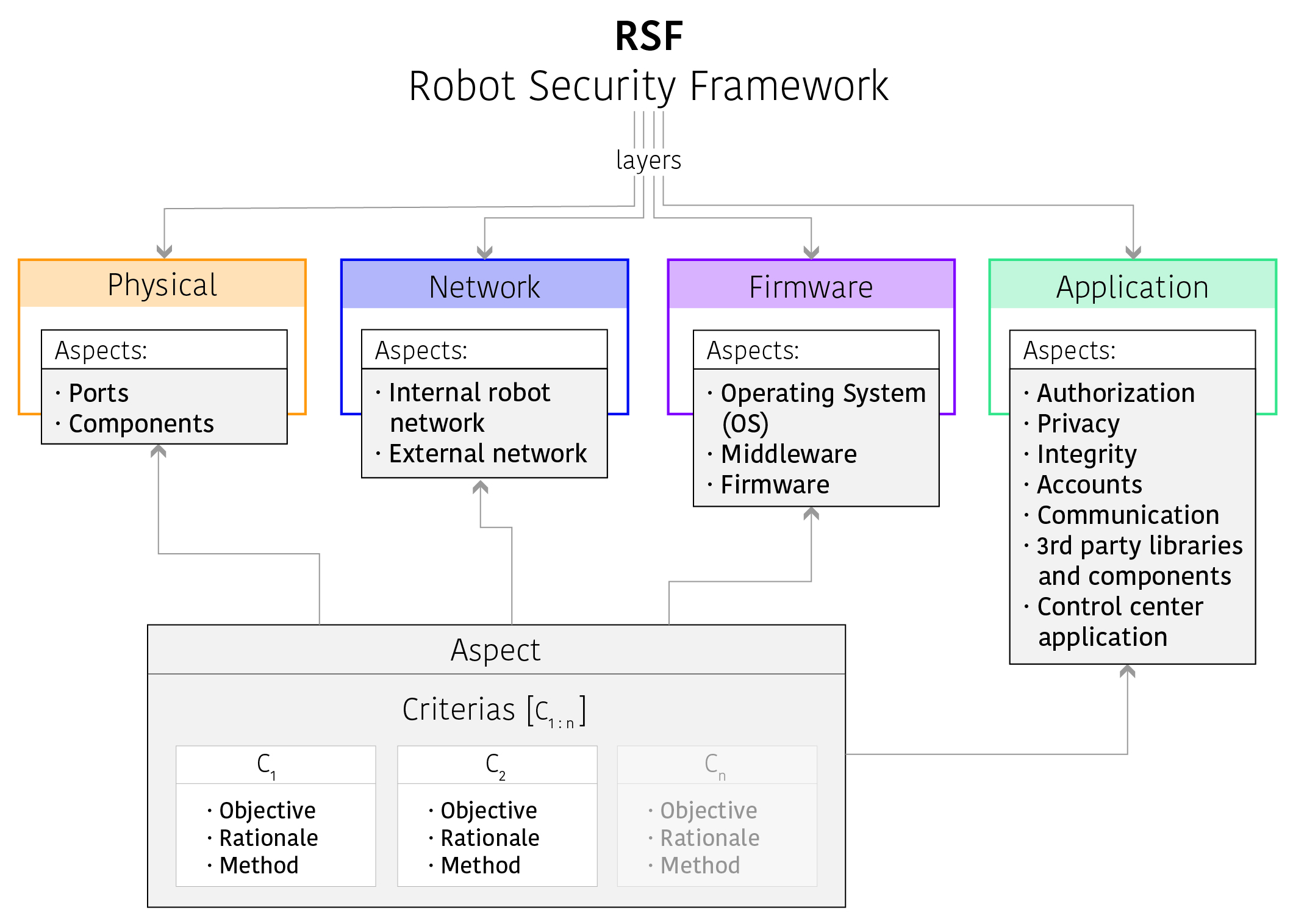
We hereby propose a framework based on four layers that are relevant to robotic systems. We subsequently divide them into aspects considered relevant to be covered. Likewise, we provide relevant criteria applicable for security assessment. For each of these criteria we identify what needs to be assessed (objective), why to address such (rationale) and how to systematize evaluation (method), as summarized in Figure 1.
3.1 Physical – layer
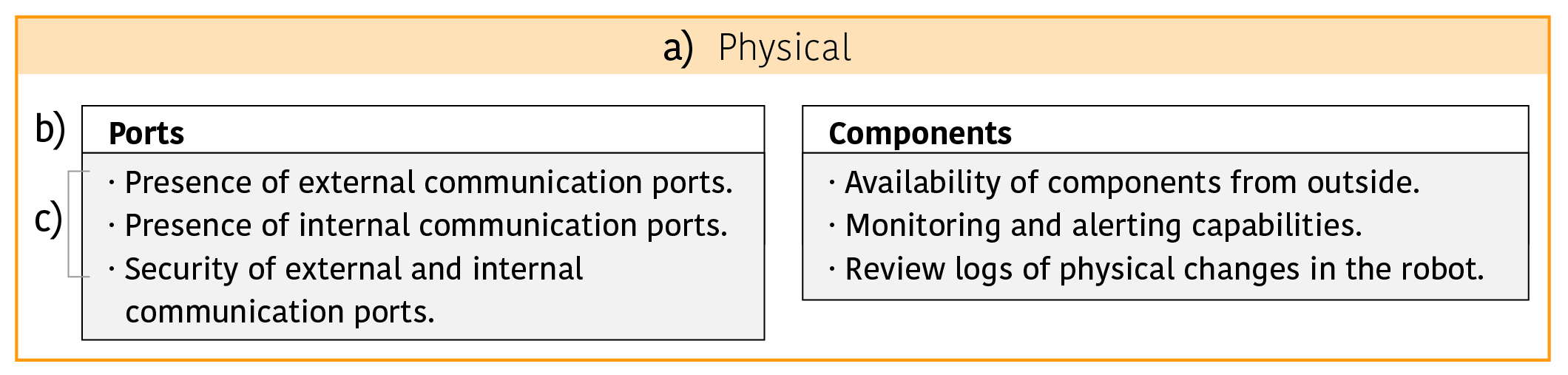
Ports – aspect
-
Presence of external communication ports – criteria
-
Objective: Identify presence of unprotected external ports.
-
Rationale: Unprotected external ports can let attackers in physical proximity to perform a variety of attacks and serve as an entry point for them.
-
Method:
-
Inspect documentation, consult developers and inspect robot’s body and components. Look for accessible ports (e.g. Ethernet, USB, CAN, etc.).
-
Open all doors which are not protected by locks and look for ports inside.
-
-
-
Presence of internal communication ports – criteria
-
Objective: Identify presence of unprotected internal ports that typically correspond with sensors, user interfaces, power or other robot-related components.
-
Rationale: Unplugging robot components can potentially lead to the exposure of internal communication ports. Typically, these internal communication ports are not protected in robots. This may serve as an entry point and allow attackers in physical proximity to perform a variety of attacks.
-
Method:
-
Firstly, open any door not protected by a lock. Secondly, open those protected, and look for robot components and their buses.
-
Investigate ventilation holes and see if they are wide enough to access internal communication ports.
-
-
As reported by Cerrudo et al.
-
Security of external and internal communication ports – criteria
-
Objective: Verify if attackers can sniff or modify any critical data during communication with a docking station or by connecting to the ports.
-
Rationale: Unprotected external and internal ports can let attackers in physical proximity to perform a variety of attacks by serving as an entry point into them.
-
Method:
-
Try to connect to the identified communication ports:
-
Determine if authentication is required (e.g. Network access control for Ethernet).
-
Assess whether the communication is encrypted.
-
Try communicating with them, attempt fuzzing to discover if robot’s state can be affected.
-
-
If a robot connects to a docking station to transfer some data, try to use sniffers to see how data exchange is being done (e.g. verify if some sensitive, configuration or control data is transferred in clear text).
-
-
Components – aspect:
-
Availability of components from outside – criteria
-
Objective: Identify internal hardware that is accessible from outside.
-
Rationale: Directly accessible components can be physically damaged, stolen, tampered, removed or completely disabled causing the robot to misbehave. The most obvious example is the removal of critical sensors for the behavior of the robot.
-
Method:
-
Inspect robots body and look for accessible components (e.g. sensors, actuators, computation units, user interfaces, power components, etc.).
-
Open all doors which are not protected by locks and look for accessible components inside.
-
-
Notes: All cables should also remain inside of the robot. Some components require to be partially outside of the body frame (e.g. certain sensors such as range finders, or antennas of certain wireless communication components), in such cases only the required part should stick out, not the whole component.
-
-
Monitoring and alerting capabilities – criteria
-
Objective: Identify whether rogue access to the internal hardware of the robot can be detected.
-
Rationale: Having no verification whether the internals of the robot were accessed or not means that attackers can easily tamper with any components or install a hardware trojan unnoticeably.
-
Method:
-
Identify all parts of the frame that can be opened or removed to get access to the components or modules.
-
Check whether there is an active (tamper switches) or passive (tamper evident screws and seals) monitoring capability present.
-
In case of active monitoring capability, verify that the operator receives a real-time alert and the incident is being logged and acted upon by reviewing procedures.
-
-
Notes: Passive monitoring provides information upon inspection, whether internals were accessed or not. However, there is still a time window between inspections when exploited robots can be abused.
-
-
Review logs of physical changes in the robot – criteria
-
Objective: Verify the logs of the robot and look for tampering actions. Log examples include powering on/off events, connection/disconnection of physical components, sensor values or actuator actions. Detect potential tampering based on this information.
-
Rationale: Most robots register logs of a variety of events going from powering on/off the robot to each individual component data. Specially, some robots detect physical changes on their components and register it. Such changes could lead to an undetected tampering of the system. Reviewing the logs could lead to discovering physical tampering of the robot.
-
Method:
-
Review the logs of powering on and off routines of the robot.
-
Review the logs of physical changes in the robot.
-
Review the logs of each individual component and look for anomalies.
-
-
3.2 Network – layer
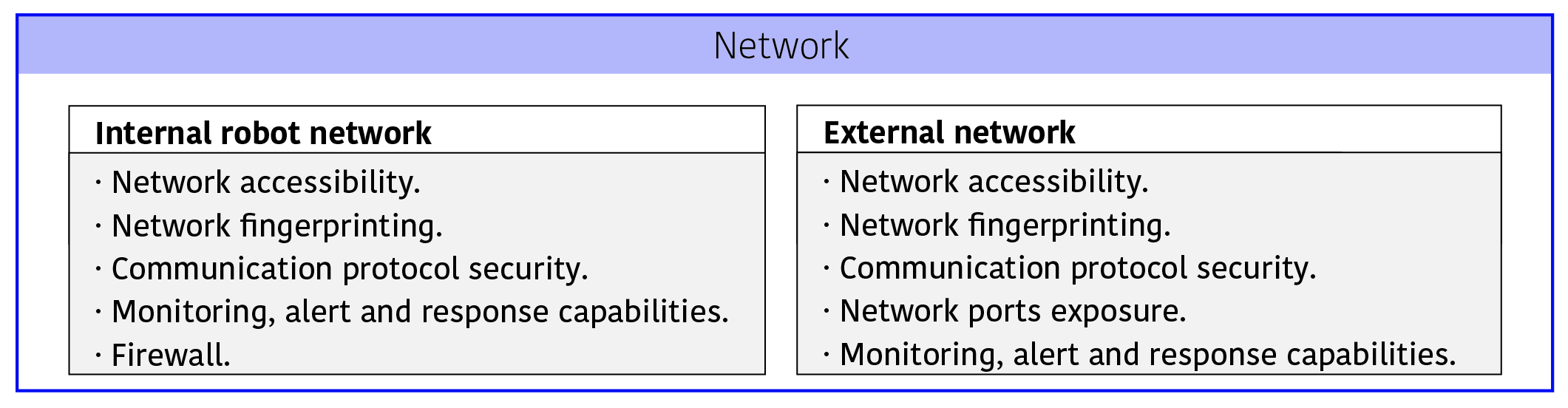
Internal robot network – aspect:
-
Network accessibility – criteria:
-
Objective: Determine and assess network accessibility and the corresponding protection mechanisms.
-
Rationale: Internal networks could be password protected. If that’s the case, the corresponding mechanisms should be up-to-date and ensure that only authenticated users are able to access the network.
-
Method
-
Validate authentication mechanisms and verify that no known vulnerabilities are present on such.
-
If internal network is password protected, attempt common password guessing.
-
Verify whether the robot logs both successful and unsuccessful login attempts.
-
-
-
Network fingerprinting – criteria:
-
Objective: Mitigate the fingerprinting impact on the internal networks.
-
Rationale: Network fingerprinting is useful to understand the internal network structure and its behavior, and to identify components’ operating system by analyzing packets from that component. This information could be used for malicious purposes, since it provides fine-grained determination of an operating system and its characteristics.
-
Method:
-
Perform fingerprinting attacks on the internal networks.
-
Evaluate obtained information with the manufacturer’s available data and assess its impact.
-
If necessary, propose a mitigation strategy through the use of ”scrubbers”, which will ”normalize” the packets, and remove the unique identifying traits that the attacker is seeking. Refer to
for more details about the use of ”scrubbers”.
-
-
-
Communication protocol security – criteria:
-
Objective: Check if used communication protocol is up-to-date, secure and has no known vulnerabilities.
-
Rationale: Vulnerabilities in communication protocols can allow attackers to gain unauthorized access to the internal network of the robot and intercept or modify any transmitted data.
-
Method:
-
Identify all present communication capabilities by inspecting documentation, by consulting developers or by manual analysis.
-
Analyze if used protocol versions provide encryption and mutual authentication.
-
Verify that used protocol is hardened according to industry standards.
-
-
-
Monitoring, alert and response capabilities – criteria:
-
Objective: Identify whether internal network activity is monitored, alerts are issued and corresponding actions are taken based on known signatures or anomalies.
-
Rationale: Proper security controls on the internal network might be challenging due to hardware limitations or performance requirements, although it is critical for robots to introspect, monitor, report and act on issues that could appear on their internal networks. Security by obscurity is unfortunately a commonly accepted approach in robotics, nevertheless, it has been demonstrated that this approach leads to critically unsecured robots. Monitoring and control capabilities should be implemented on the internal network of the robot either through the manufacturer or through additional or external solutions. The decision of applying counter-measures to the attack or only alerting should be determined by the impact of possible false positives on the operative of the robot.
-
Method:
-
Sweep the internal robot network and enumerate entry points (e.g. open ports, existing component information, network map of components, etc).
-
Try to match the fingerprints identified and to map known vulnerabilities.
-
Connect to the network and attempt to perform network-based attacks (e.g. ARP poisoning, denial of service on a particular component, etc.).
-
Verify whether the robot detects and registers incidents.
-
Verify whether the robot acts upon such events and either:
-
(The robot) responds to insult proactively.
-
An operator receives a real time alert and acts based on procedures.
-
-
-
Notes: In those cases where it is not possible to implement internal robot network monitoring, alerting and response due to limitations on the robot capabilities, manufacturers should extend their capabilities or refer to third party solutions that could offer such.
-
-
Firewall – criteria:
-
Objective: Identify whether internal network is separated from the external by the firewall.
-
Rationale: Firewalls can help to further protect components, modules and communications from the outside and ensure that they cannot accidentally leak data to the external network.
-
Method:
-
Inspect documentation, consult developers and inspect components which are responsible for external communications. Identify that such components have firewalls.
-
Inspect firewall settings and verify that no components or modules are allowed to communicate to the external network unless it is necessary.
-
If a VPN is used, verify that there are rules which allow components or modules to communicate with the outside world only via the VPN tunnel.
-
-
Notes: There should be a firewall per each interface with external networks. This means that each communication component interfacing with an external channel should have a firewall behind it or use third party solutions. For example, WiFi hotspots in robots or LTE/UMTS transceivers.
-
Robots are typically built by interconnecting different components (sensors, actuators, communication devices, etc.) through internal networks. Most manufacturers, aware about the security risks, allocate resources in the protection of the interface with external networks through firewalls, IDSs or other mechanisms. To the best of our knowledge, few robotic solutions care about internal networking. Most internal networks in robotic solutions are totally unprotected, often unencrypted, and even when encrypted, authentication is unhandled, which can easily lead to Denial-of-Service (DoS) attacks. Some pioneering pieces of research
This security fault was illustrated in Cerrudo and Apa’s work
External network – aspect:
-
Network accessibility – criteria:
-
Objective: Determine and assess network accessibility and the corresponding protection mechanisms.
-
Rationale: External networks could be password protected. If that is the case, the corresponding mechanisms should be up to date and ensure that only authenticated users are able to access the network.
-
Method:
-
Validate authentication mechanisms and verify that no known vulnerabilities are present on such.
-
If external network is password protected, attempt common password guessing.
-
Verify whether the robot logs successful and unsuccessful login attempts.
-
-
As reported by Cerrudo and Apa
-
Network fingerprinting – criteria:
-
Objective: Mitigate the fingerprinting impact on the external networks.
-
Rationale: Network fingerprinting is useful to understand the network structure and its behavior, as well as to identify devices’ operating system by analyzing packets from that network. This information could be used for malicious purposes since it provides fine-grained determination of an operating system and its characteristics.
-
Method:
-
Perform fingerprinting attacks on the external network.
-
Evaluate obtained information with the manufacturer’s available data and assess its impact.
-
If necessary, propose a mitigation strategy through the use of ”scrubbers”, which will ”normalize” the packets, and remove the unique identifying traits that the attacker is seeking. Refer to
for more details about the use of ”scrubbers”.
-
-
According to Cerrudo and Apa
-
Softbank Robotics’ Nao default hostname is ”nao.local”.
-
Softbank Robotics’ Pepper default hostname is ”nao.local”, also publicly available in the official documentation
. -
Rethink Robotics’ Baxter and Sawyer default hostname is the serial number followed by local. E.g. ”011303P0017.local” or ” \(<robotname>.local\) ”, also confirmed in Rethink’s official documentation
. -
Universal Robots’ UR3, UR5 and UR10 default hostname is ”ur.local”.
All of them hardcoded, regardless of the device itself.
-
Communication protocol security – criteria
-
Objective: Check if used communication protocol is up-to-date, secure and has no known vulnerabilities.
-
Rationale: Vulnerabilities in communication protocols can allow attackers to gain unauthorized access to the external network of the robot and intercept or modify any transmitted data.
-
Method:
-
Identify all communication capabilities being present by inspecting documentation, consulting developers or by manual analysis.
-
Analyze if used protocol versions provide encryption and mutual authentication.
-
Verify that used protocol is hardened according to industry standards.
-
-
Notes: If providing encryption on the protocol level is not possible for some reasons, VPN or application level encryption should be used.
-
-
Network ports exposure – criteria:
-
Objective: Identify whether only necessary network ports are exposed to the external network.
-
Rationale: More open ports mean a bigger attack surface and therefore their number should be as low as possible. Services that are exposed should have no known vulnerabilities due to the ease of their exploitation.
-
Method:
-
Connect to the network that is being used by the robot for communication and scan all robot ports to find the open ones. Verify in manufacturer manuals whether their presence is required.
-
Identify, if possible, services running behind an open port and its version.
-
Verify whether identified services are still receiving security updates and have no known vulnerabilities.
-
-
-
Monitoring, alert and response capabilities – criteria
-
Objective: Identify whether the external network activity is being monitored, alerts are issued based on known signatures or anomalies, and appropriate actions are taken.
-
Rationale: Properly configured external network monitoring can spot network based attacks in their inception even if other security mechanisms are compromised.
-
Method:
-
Sweep the external robot network and enumerate entry points (e.g. open ports, protocol information, network map of components, robot components etc.).
-
Try to match the fingerprints identified and map to known vulnerabilities.
-
Perform network based attacks (e.g. ARP poisoning, denial of service on a particular component).
-
Verify whether the robot detects and registers incidents on the external network.
-
Verify whether the robot acts upon such events and either:
-
(The robot) responds to insult proactively.
-
An operator receives a real time alert and acts based on procedures.
-
-
-
Notes: In those cases where it is not possible to implement external robot network monitoring, alerting and response due to limitations on the robot capabilities, manufacturers should extend their capabilities or refer to third party solutions that could offer such.
-
3.3 Firmware – layer

Operating System (OS) – aspect
-
Underlying OS updates – criteria
-
Objective: Verify that the used Operating System (OS) is still supported by the manufacturer and there is a mechanism to perform system updates.
-
Rationale: Outdated operating systems can have security vulnerabilities.
-
Method:
-
Check if the underlying OS is still maintained and able to recieve security patches.
-
Check whether the latest security updates are applied.
-
Check if there is an update mechanism present and enabled.
-
Check if updates are authenticated when transferred to the robot.
-
-
Middleware – aspect
-
Verify code compliance (if accessible) – criteria
-
Objective: In those cases where it applies (white box assessment), ensure compliance of middleware code against established compliance mechanisms.
-
Rationale: As robotics and autonomy grow, especially in certain fields of robotics, users of middlewares need to be able to determine if the software is able to be used in a safety-critical environment. With suitable guidance and modification, it is expected that middleware code could be integrated as part of certain compliant system. For this purpose, code should be developed and reviewed following certain guidelines. The most common one is the Motor Industry Software Reliability Association (MISRA), widely used in many safety-critical environments and adopted by the ROS 2 middleware.
-
Method:
-
Determine the exact set of guidelines that are being applied.
-
Validate whether these guidelines have been implemented.
-
-
-
Middleware updates – criteria
-
Objective: Verify that the used middleware is still maintained and supported by the manufacturer. Verify the capacity to perform system updates.
-
Rationale: Outdated middlewares in robotics are subject to have security vulnerabilities. This is specially true with ROS, ROS 2 and other robot-related middlewares.
-
Method:
-
Check if the underlying middleware is still maintained and able to recieve security patches.
-
Check whether the latest security updates are applied.
-
Check if there is an update mechanism present and enabled.
-
Check if the updates are encrypted when transferred to the robot.
-
-
Firmware – aspect
-
Firmware updates – criteria
-
Objective: Check if manufacturer firmware can be securely updated.
-
Rationale: If new vulnerabilities are discovered it is important to ensure that there is a way to provide updates to all the devices that are already sold to customers. However, update mechanisms can be circumvented by an attacker to deliver malicious updates. Therefore, it is important to verify the origin of the update prior to installation.
-
Method:
-
Identify if there is a mechanism to deliver firmware updates.
-
Verify whether updates are cryptographically signed.
-
Verify that the signature is verified prior to installation.
-
-
As reported by Cerrudo and Apa
3.4 Application – layer
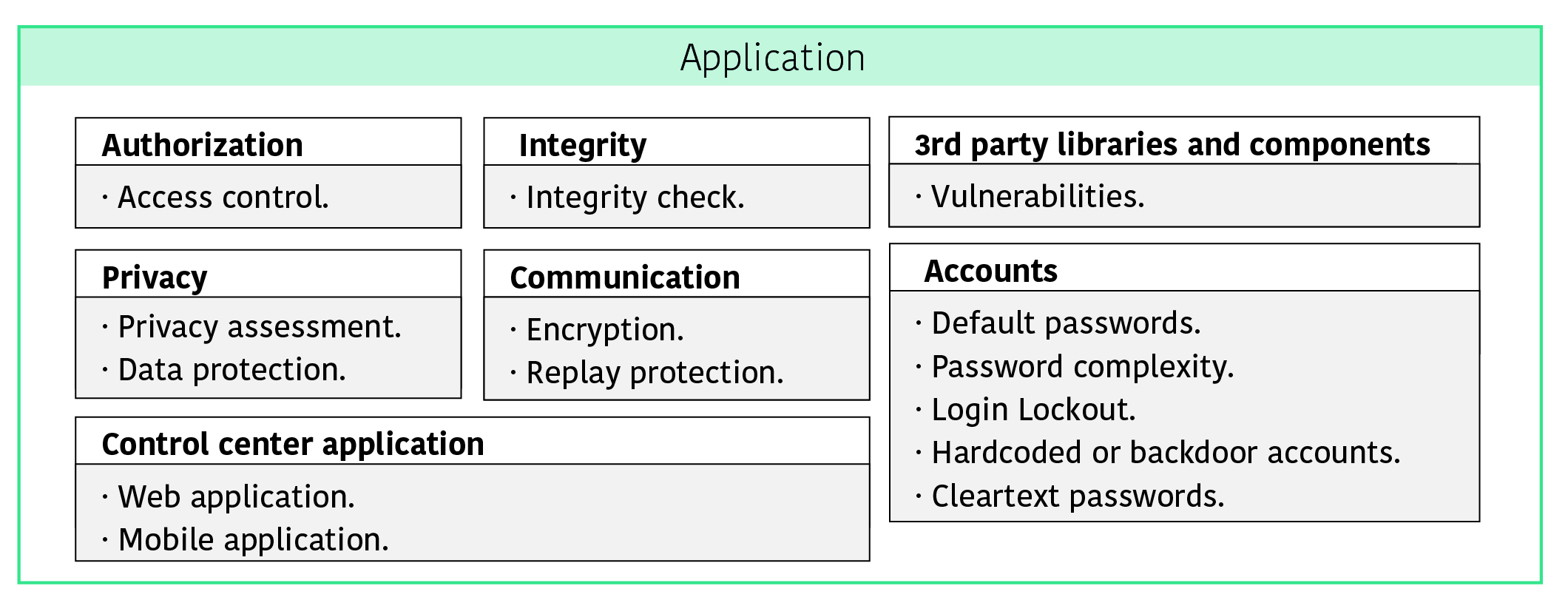
Authorization – aspect
-
Access control – criteria
-
Objective: Verify that resources are accessible only to authorized users or services.
-
Rationale: Access to the restricted functions by anonymous users or users with lower access control rights diminishes all the benefits of access control.
-
Method:
-
Log in with authorized credentials and attempt to perform different actions, record the requests that are being made.
-
Log out and attempt to send the same requests as an unauthenticated user. Verify whether it is successful.
-
Log out and log in again as a user with lower access rights. Attempt to send the same requests again. Verify whether it is successful.
-
-
Privacy – aspect
-
Privacy assessment – criteria
-
Objective: Identify whether the robot is compliant to the privacy policies that apply.
-
Rationale: Not complying with privacy standards could result in a breach of personal data.
-
Method:
-
Verify that minimum Personally Identifiable Information (PII) is collected and transmitted over the internet.
-
Verify that if PII is collected users are made aware of it (e.g. in case of a video recording people can be warned by stickers or signs on the robot).
-
Verify that all PII is stored and transmitted in a secure manner.
-
-
-
Data protection – criteria
-
Objective: Identify whether the robot manufacturer emplaces mechanisms to ensure compliance to the data protection regulations and laws that apply. Particularly, General Data Protection Regulation (GDPR) in the EU.
-
Rationale: Not complying with regulations could result in penalties.
-
Method:
-
Assess the legitimate interests.
-
Assess the consent.
-
Assess the information provisions.
-
Assess the third party data.
-
Assess the profiling.
-
Assess the legacy data.
-
-
Note: This criteria is not relevant to the security of the robot itself. However, not complying with data protection regulations can result in financial penalties and should therefore be taken into consideration in organizations using robots.
-
Integrity – aspect
-
Integrity check – criteria
-
Objective: Identify whether the system performs an integrity check of critical components and takes action if they are not present or modified.
-
Rationale: Tampering with any of the critical components can make the robot cause physical damage to people and property.
-
Method:
-
Consult documentation and developers to find whether integrity check for critical components is present.
-
Try disabling or modifying critical components (e.g. safety sensors or range finding systems) of the robot and check if the operator receives a real-time alert and the incident is being logged.
-
Check whether the robot continues to function afterwards. Its operation should be stopped as soon as any critical component is disabled or modified, (e.g. if a proximity sensor is disabled the robot should not be able to move, because it will not be able to spot obstacles and can easily do some physical damage).
-
-
Note: Critical components are those that can directly influence the robot’s operation, functionality or safety.
-
Accounts – aspect
-
Default passwords – criteria
-
Objective: Identify presence of default passwords.
-
Rationale: Default passwords are easily accessible online and remain the most popular and effortless way to exploit internet connected devices.
-
Method:
-
Review documentation and consult developers to identify whether default passwords are used.
-
Attempt to log in with commonly used passwords.
-
If default passwords are used, verify whether their change is encouraged on the first use.
-
If unique passwords are created on a per device basis, ensure that they are random and not in a sequential order.
-
-
Note: When trying commonly used passwords, beware of account lockouts and verify that there is a recovery mechanism present.
-
-
Password complexity – criteria
-
Objective: Verify that password complexity is enforced.
-
Rationale: Weak passwords may take little time to guess.
-
Method: Attempt to change the password to a weak one and verify whether this change succeeded.
-
Note: Password complexity requirements depend on the sensitivity of the application. In general, the minimum requirements that should be in place are:
-
A password length of, at least, 8 characters.
-
Enforce the usage of 3 of these 4 categories:lower-case, upper-case, numbers, special characters.
-
-
-
Login Lockout – criteria
-
Objective: Identify whether the login lockout is present.
-
Rationale: Having strong and non-default passwords may not be enough. Brute force attempts should be prevented by implementing a login lockout mechanism.
-
Method: Attempt to log in with incorrect credentials multiple times. Verify that the account has got a lockout.
-
Note: The lockout threshold depends on the sensitivity of the service. In general, there should be 5 login attempts or less. Prior to testing, verify that the lockout recovery mechanism is being present. Accounts can be either locked out for a specific duration of time and/or they can be recovered by physical interaction with the robot.
-
-
Hardcoded or backdoor accounts – criteria
-
Objective: Identify presence of hardcoded or backdoor accounts.
-
Rationale: Hardcoded or backdoor credentials pose the same danger as default passwords. However, their identification is usually harder due to the need for reverse engineering or possession of the source code.
-
Method:
-
Consult documentation and developers to identify whether hardcoded or backdoor credentials are used.
-
Analyze the source code for hardcoded or backdoor credentials.
-
-
-
Cleartext passwords – criteria
-
Objective: Identify whether passwords are stored in cleartext.
-
Rationale: Cleartext passwords can be leveraged by an attacker for privilege escalation or lateral movement.
-
Method:
-
Review the source code and documentation, consult developers and identify whether passwords are stored in a cleartext.
-
-
Note: Lockout threshold depends on the sensitivity of the service. In general, there should be 5 login attempts or less.
-
Communication – aspect
-
Encryption – criteria
-
Objective: Ensure that all sensitive data is transmitted over an encrypted channel.
-
Rationale: If data is transmitted in a cleartext attackers can easily gather sensitive information (e.g. credentials, audio and video streams, private data).
-
Method:
-
Intercept connection between a robot and a control center application or a cloud server.
-
Use protocol analyzer to verify that transmitted data is encrypted.
-
-
-
Replay protection – criteria
-
Objective: Ensure that transmitted data cannot be replayed.
-
Rationale: If replay protection is absent, attackers can record legitimate packets and then arbitrarily replay them to achieve desired actions.
-
Method:
-
Intercept the connection between the robot and a control center application or a cloud server.
-
Record the control or configuration packets sent to/by the robot.
-
Attempt to replay the packets and verify whether the desired action is executed.
-
-
3rd party libraries and components – aspect
-
Vulnerabilities – criteria
-
Objective: Verify that 3rd party software components do not have known vulnerabilities.
-
Rationale: It is quite common to blindly rely on 3rd party components. However they can easily introduce a vulnerability into the product where they are used.
-
Method:
-
Identify which 3rd party libraries and components are used and what are their versions.
-
Look for known vulnerabilities in the current version.
-
Verify whether the identified component is still receiving security updates and has no unpatched vulnerabilities.
-
Verify that the latest security updates are installed.
-
-
Control center application – aspect
-
Web application – criteria
-
Objective: Perform a security assessment of the web application.
-
Rationale: The robot can be indirectly compromised if the attacker exploits a web control center application.
-
Method:
-
Identify web interface that is being used (hosted on the robot itself or a cloud server).
-
Use OWASP methodology to test web application against OWASP Top 10 Web application vulnerabilities.
-
-
-
Mobile application – criteria
-
Objective: Perform a security assessment of the mobile application.
-
Rationale: The robot can be indirectly compromised if the attacker exploits a mobile phone control center application.
-
Method:
-
Identify whether the robot has a mobile app that can be used to control or interact with it.
-
Test the application against OWASP Mobile Top 10.
-
-
According to Cerrudo and Apa
4 Conclusions and future work
Robot privacy, integrity and security should be major concerns in a society that increasingly relies on such cyber-physical systems. Few honest efforts have been conducted to address robot security systematics. However, a deep understanding of the discipline’s landscape, along with vast cross-disciplinary approaches, is crucial to provide an integrated security assessment for robotics. The research work herein presents the Robot Security Framework (RSF): a standardized methodology that enables holistic evaluation of robot security. Furthermore, RSF is provided with illustrative practical real-world examples. Following a roboticist’s security approach, our contribution aims at shedding light onto the robot security scene, an area which has remained obscure insofar. Now as then, as well as for the future, we are convinced that a reliable, reproducible and systematic security assessment is a must in any modern use-case of robotics.
Future research is envisioned with regard to constant improvement and testing of RSF. An open source template of our security framework is available at http://github.com/aliasrobotics/RSF and licensed under GPLv3. We kindly invite security researchers, robotic researchers and analysts to review, challenge and complement our work.
5Acknowledgements
This research has been partially funded by the Basque Government, throughout the Business Development Agency of the Basque Country (SPRI) through the Ekintzaile 2018 program. Special thanks to BIC Araba for the support provided.