Abstract. We present a systematic security assessment of the Unitree G1 humanoid showing it operates simultaneously as a covert surveillance node and can be purposed as an active cyber operations platform. Initial access can be achieved by exploiting the BLE provisioning protocol which contains a critical command injection vulnerability allowing root access via malformed Wi-Fi credentials, exploitable using hardcoded AES keys shared across all units. Partial reverse engineering of Unitree’s proprietary FMX encryption reveal a static Blowfish-ECB layer and a predictable LCG mask—enabled inspection of the system’s otherwise sophisticated security architecture, the most mature we have observed in commercial robotics. Two empirical case studies expose the critical risk of this humanoid robot: (a) the robot functions as a trojan horse, continuously exfiltrating multi-modal sensor and service-state telemetry to 43.175.228.18:17883 and 43.175.229.18:17883 every 300 seconds without operator notice, creating violations of GDPR Articles 6 and 13; (b) a resident Cybersecurity AI (CAI) agent can pivot from reconnaissance to offensive preparation against any target, such as the manufacturer’s cloud control plane, demonstrating escalation from passive monitoring to active counter-operations. These findings argue for adaptive CAI-powered defenses as humanoids move into critical infrastructure, contributing the empirical evidence needed to shape future security standards for physical–cyber convergence systems.
Full text transcribed from the original publication source.
+---------------------------------------------------------------------+| UNITREE G1 ROBOT SYSTEM |+---------------------------------------------------------------------+| Hardware Layer (ARM64) || CPU: ARMv8 | RAM: 8GB | Storage: eMMC | Network: ETH/WiFi/BT |+---------------------------------------------------------------------+ |+---------------------------------------------------------------------+| Linux Kernel 5.10.176-rt86+ || Real-Time Preemption Patches |+---------------------------------------------------------------------+ |+---------------------------------------------------------------------+| MASTER SERVICE (ROS 2 Foxy, CycloneDDS 0.10.2, EOL May 2023) || Service Orchestration & Management || +--------------------------------------------------------------+ || | Config: /unitree/module/master_service/master_service.json | || | Socket: /unitree/var/run/master_service.sock | || | Encryption: FMX (Blowfish + LCG) | || +--------------------------------------------------------------+ |+---------------------------------------------------------------------+ | +---------------------------+---------------------------+ | | |+-------v------+ +---------v--------+ +--------v------+| Priority | | Initialization | | Runtime || Services | | Services | | Services |+--------------+ +------------------+ +---------------+| * net-init | | * pd-init | | * ai_sport || * ota-box | | * lo-multicast | | * motion_ || * ota-update | | * upper_bluetooth| | switcher |+--------------+ | * iox-roudi | | * robot_state_service | * basic_service | | * state_ | +------------------+ | estimator | | * ros_bridge | | * chat_go | | * vui_service | | * webrtc_* | +---------------+

1Introduction
This technical brief summarizes the findings from Alias Robotics’ security assessment in combination with researchers Andreas Makris3 and Kevin Finisterre2 independent findings
-
Disovered the FMX encryption, which exhibits fundamental cryptographic weaknesses. The dual-layer scheme employs Blowfish-ECB with a static 128-bit key (effective entropy: 0 bits due to fleet-wide key reuse across all devices) combined with a partially reverse-engineered LCG obfuscation layer (limited to 32-bit seed space). This violates Kerckhoffs’s principle—security relies on key secrecy, not algorithm obscurity
. -
BLE provisioning enables trivial remote compromise. The Wi-Fi configuration protocol accepts unvalidated input through BLE channels, allowing command injection via SSID/password fields using the pattern
;$(cmd);#. Combined with hardcoded AES-CFB keys (df98b715d5c6ed2b25817b6f2554124a) shared across all G1, H1, and R1 units (also applicable to Go2 and B2 legged robots), any attacker within Bluetooth range achieves root code execution1. -
Persistent telemetry violates data sovereignty. MQTT connections to servers at 43.175.228.18:17883 and 43.175.229.18:17883 transmit sensor fusion data at 1.03 Mbps and 0.39 Mbps respectively, with auto-reconnect ensuring continuous surveillance.
-
Humanoid robot platform represents a bidirectional attack vector. The G1’s compromised cryptography and network exposure enable both remote exploitation for surveillance/control and deployment as a mobile cyber-physical weapon platform capable of lateral movement within air-gapped facilities.
-
Cybersecurity AI demonstrates autonomous exploitation capability. The CAI framework successfully identified and prepared exploitation of authentication bypass vulnerabilities, showcasing the platform’s potential as an offensive cyber weapon.
The remainder of the brief walks through the platform’s anatomy, BLE provisioning vulnerabilities, the FMX cryptanalytic analysis, the telemetry pipeline, and validated attack vectors before closing with what the dual-threat reality means.
2Platform Anatomy
2.1Hardware Baseline
Hardware analysis reveals the G1’s compute platform centers on a Rockchip RK3588 SoC (quad-core Cortex-A76 @ 2.4GHz + quad-core Cortex-A55 @ 1.8GHz) with 8GB LPDDR4X RAM and 32GB eMMC storage. Physical security weaknesses include exposed JST debug connectors, unpopulated JTAG pads, and accessible UART interfaces operating at 115200 baud. The sensor array comprises Intel RealSense D435i depth cameras (1280×720 @ 30fps depth, 1920×1080 @ 30fps RGB), dual MEMS microphones, 9-axis IMU, and GNSS receiver—all publishing to DDS topics on the local network. Some of these sensors are susceptible to established attack vectors including optical channel exploitation
2.2BLE Provisioning Vulnerability
The robot’s Bluetooth Low Energy provisioning interface, accessible on models G1, H1, and R1 (also applicable to Go2 and B2 legged robots), contains a critical command injection vulnerability. The Wi-Fi configuration protocol accepts SSID and password fields without sanitization, allowing attackers to inject shell commands using the pattern ;$(command);#. All BLE traffic uses AES-CFB encryption with a static key (df98b715d5c6ed2b25817b6f2554124a) and IV (2841ae97419c2973296a0d4bdfe19a4f) hardcoded across the entire fleet, reducing effective entropy to zero. Exploitation requires only BLE proximity and knowledge of these universal credentials, enabling remote code execution with root privileges through the provisioning daemon. The vulnerability persists across firmware versions, with successful exploitation granting persistent access via SSH, credential modification, or arbitrary command execution1.
2.3Service Orchestration
The 9.2 MB master_service binary supervises 26 daemons grouped into priority, initialisation, and runtime pools. Runtime profiling recorded ai_sport consuming roughly 145% CPU (multi-core), state_estimator near 30%, with persistent load from robot_state, vui_service, webrtc_bridge, and chat_go. Their configuration archives are wrapped by FMX and therefore inherit the weaknesses documented in Section 3.
2.4Communication Surfaces
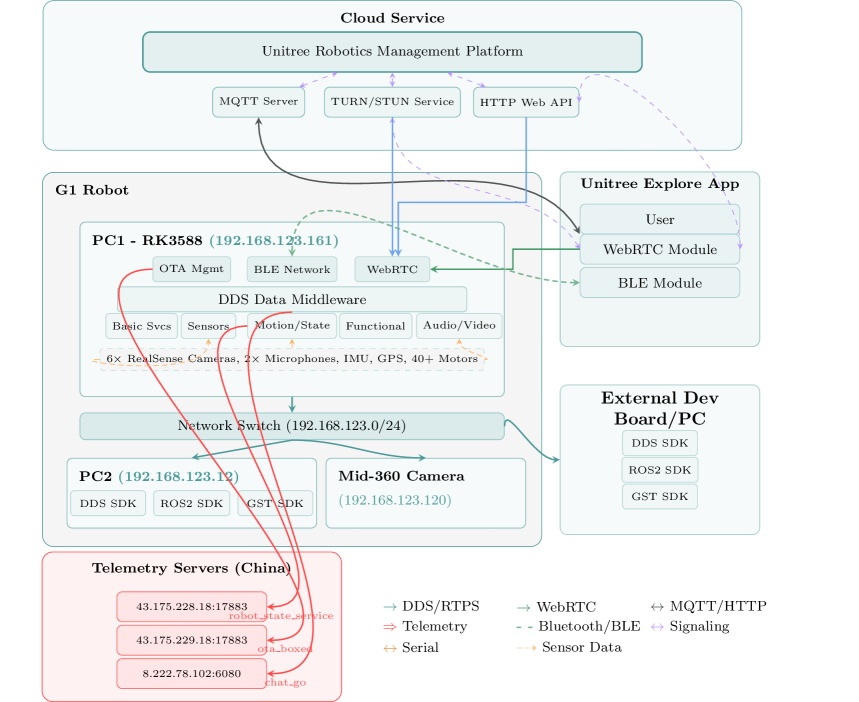
Multiple live channels operate simultaneously:
-
DDS/RTPS for intra-robot publish/subscribe messaging (unencrypted and susceptible to local interception).
-
MQTT on port 17883 for telemetry and OTA coordination with 43.175.228.18 and 43.175.229.18.
-
WebRTC via webrtc_bridge for media streaming, with TLS certificate verification disabled in the shipped client.
-
BLE/Wi-Fi links via upper_bluetooth and chat_go for mobile or app-based control. The BLE channel specifically exposes the command injection vulnerability.
The overlap between unencrypted local buses and authenticated cloud uplinks enables the cross-layer attacks explored later in this brief.
3FMX Cryptanalysis
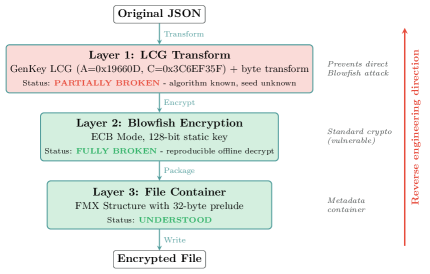
Designated “FMX”, the Unitree’s encryption employs a dual-layer architecture for configuration protection. Our partial reverse engineering revealed the outer layer uses Blowfish-ECB with a fleet-wide static key, while the inner layer implements a Linear Congruential Generator (LCG) for obfuscation as depicted in Figure 2. While we successfully broke the outer encryption layer and identified the LCG algorithm parameters, complete reversal of the seed derivation mechanism remains unfinished.
3.1Layer 2 (Outer): Static Blowfish Encryption—FULLY BROKEN
-
Algorithm: Blowfish cipher in ECB mode (64-bit blocks, no IV).
-
Key Recovery: Static 128-bit key extracted from master_service binary through symbol analysis of unitree::security::Mixer class.
-
Security Impact: Fleet-wide key reuse confirmed across multiple G1 units reduces effective entropy to 0 bits—compromising one device exposes the entire fleet. ECB mode enables pattern analysis attacks and provides no authentication guarantees.
Key: 44c56a97ccf33d585a91c18e1c72382b
Mode: ECB (no IV), Status: COMPROMISED
3.2Layer 1 (Inner): LCG Obfuscation—PARTIALLY BROKEN
-
Algorithm: Linear Congruential Generator with parameters matching glibc’s rand(): \(X_{n+1}=(1664525\cdot X_{n}+1013904223)\bmod 2^{32}\) (where 1664525 = 0x19660D, 1013904223 = 0x3C6EF35F).
-
Key Extraction: High byte of each LCG state used as XOR key: key[i] = (state >> 24) & 0xFF.
-
Seed Derivation: While we identified the LCG algorithm, the exact seed derivation from device identifiers remains partially understood. The 32-bit seed space is tractable for brute force but was not fully explored.
-
Current Status: Algorithm reverse-engineered, parameters identified, seed generation incompletely documented.
4Telemetry Exposure
4.1Captured Data Surface
Our SSL_write instrumentation on 9 September 2025 captured a 10-minute telemetry session, revealing structured JSON payloads of 4.5–4.6 KB transmitted at 300-second intervals. Each frame contained:
-
Battery telemetry (cell voltages, currents, temperatures, SoC).
-
IMU orientation (pitch, roll, yaw) alongside torque and temperature from every joint.
-
Service inventories reporting enablement state for motion, voice, perception, and OTA modules.
-
Resource metrics (CPU load arrays, memory usage, filesystem statistics).
The telemetry architecture employs a dual-channel design: periodic MQTT state reports (300-second intervals) complement continuous DDS streams carrying real-time sensor data. The DDS topics including audio (rt/audio_msg), video (rt/frontvideostream), LIDAR point clouds (utlidar/cloud), and proprioceptive feedback enable passive extraction of this data by simply listening to network traffic on the local network segment.
4.2Exfiltration Channels and Throughput
Two MQTT endpoints anchor the exfiltration pipeline:
-
43.175.228.18:17883: primary broker for robot_state_service (approximately 1.03 Mbps during capture).
-
43.175.229.18:17883: secondary broker for ota_boxed failover (approximately 0.39 Mbps steady state).
The chat_go service maintains a WebSocket connection to 8.222.78.102:6080 with SSL verification disabled, enabling conversational transcripts and control messages to transit outside the MQTT path. All connections auto-recover within seconds of disruption, reinforcing the platform’s always-on data posture.
4.3Legal and Sovereignty Exposure
Streaming multi-modal telemetry to Chinese infrastructure invokes that country’s cybersecurity law, mandating potential state access. In European deployments the absence of consent or transparency mechanisms contravenes GDPR Articles 6 and 13, while California operators lack the opt-out required by the CCPA. Sensitive facilities face an additional national-security risk: continuous audio, video, spatial maps, and actuator states can be relayed off-site in real time with no user awareness.
5Attack Vectors: Dual-Threat Humanoid Platforms
The G1 ultimately behaved as a dual-threat platform: covert surveillance at rest, weaponised cyber operations when paired with the right tooling. Two case studies illustrate the spectrum of risk.
5.1Case Study 1: Humanoids as Surveillance Trojan Horses
Network analysis conducted in September 2025 documented the G1’s persistent connectivity behavior: MQTT client processes (robot_state_service PID 1226, ota_boxed PID 691) establish TLS 1.3 connections to servers at 43.175.228.18:17883 and 43.175.229.18:17883 within 5 seconds of system initialization. Our SSL_write instrumentation on 9 September captured telemetry transmissions at 300-second intervals (configured via ReportInterval parameter), each containing comprehensive system state.
While our limited telemetry inspection didn’t allow us to confirm this, we observed the following surveillance channels in the robot’s computational graph:
Observed surveillance channels:
-
Audio: Continuous capture via vui_service through dual microphones, streaming to rt/audio_msg DDS topic without user indicators
-
Visual: RealSense camera at 1920×1080@15fps with H.264 encoding, cloud streaming via Amazon Kinesis SDK
-
Spatial: LIDAR point clouds (utlidar/cloud), 3D voxel mapping, GPS/GNSS positioning with sub-centimeter odometry tracking
Given the covert nature of the robot data collection, we argue that the channels described above could be used to conduct surveillance on the robot’s surroundings, including audio, visual, and spatial data. This combination enables silent meeting capture, document imaging, facility mapping, and behavioural profiling—everything needed for corporate espionage—while routing the results offshore without operator awareness.
5.2Case Study 2: Weaponized Cybersecurity AI Platform
We deployed the Alias Robotics Cybersecurity AI (CAI) framework
-
Recon. Enumerated live connections and identified MQTT/WebSocket/WebRTC endpoints reachable from inside the robot. Additionally confirmed the BLE provisioning vulnerability allows trivial initial compromise using hardcoded AES keys.
-
Exploitation rehearsal. Attempted broker logins using the recovered credentials (anonymous access rejected, certificate-authenticated sessions prepped but withheld during ethical testing), demonstrating the feasibility of command injection via both BLE provisioning and direct telemetry spoofing.
-
Attack planning. Produced an attack surface matrix covering BLE-based command injection, MQTT topic abuse, WebRTC stream hijack, and OTA manipulation pathways.
The CAI leveraged the robot’s authenticated position within Unitree’s infrastructure to enumerate attack vectors without triggering defensive mechanisms. This demonstration validates the dual-use risk: platforms designed for legitimate telemetry can be repurposed for offensive operations. The autonomous nature of CAI-driven attacks—operating at machine speed without human intervention—necessitates equivalent defensive capabilities.
6Conclusion: The Dual Threat and the Cybersecurity AI Imperative
This paper presents a systematic security assessment of the Unitree G1 humanoid robot platform, demonstrating its dual functionality as both a surveillance vector and an active cyber operations platform. Through static analysis and runtime behavioral observation, we conducted partial reverse engineering of Unitree’s proprietary FMX encryption scheme, enabling comprehensive evaluation of the platform’s security architecture. Our analysis indicates this represents the most sophisticated security implementation observed in commercial robotics platforms to date, much more mature than the industry average as depicted in Table 1.
| Feature | G1 Robot | Industry Average |
| Encrypted Config | ✓ | × |
| Dynamic Credentials | ✓ | × |
| Hardware Binding | ✓ | \(\sim\) |
| Multi-layer Defense | ✓ | × |
| No Hardcoded Secrets | ✓ | × |
Despite this robust security posture, we identified vulnerabilities that enable the robot to function as an attack vector, validated through two empirical case studies: (a) trojan horse deployment for covert data exfiltration and (b) platform compromise for lateral movement operations. Network traffic analysis via SSL_write capture over a 10-minute observation period confirmed continuous telemetry transmission to remote servers (43.175.228.18:17883 and 43.175.229.18:17883), transmitting multi-modal sensor data and service state information at 300-second intervals without explicit user consent or notification mechanisms. This data collection architecture presents potential violations of privacy regulations including GDPR Articles 6 (lawfulness of processing) and 13 (information to be provided). Beyond passive surveillance documentation, we operationalized a Cybersecurity AI (CAI) agent on the Unitree G1 platform to conduct reconnaissance and prepare exploitation vectors against the manufacturer’s cloud infrastructure, demonstrating escalation pathways from covert data collection to active offensive cyber operations. Our findings indicate that securing humanoid robots requires fundamental paradigm shifts toward adaptive Cybersecurity AI frameworks
7Acknowledgments
CAI was developed by Alias Robotics and co-funded by the European Innovation Council (EIC) as part of the accelerator project "RIS" (GA 101161136) - HORIZON-EIC-2023-ACCELERATOR-01 call.
Disclosure: Findings reported to manufacturer prior to publication.