Abstract. Cybersecurity lessons have not been learnt from the dawn of other technological industries. In robotics, the existing insecurity landscape needs to be addressed immediately. Several manufacturers profiting from the lack of general awareness are systematically ignoring their responsibilities by claiming their insecure (open) systems facilitate system integration, disregarding the safety, privacy and ethical consequences that their (lack of) actions have. In an attempt to raise awareness and illustrate the ”insecurity by design in robotics” we have created Akerbeltz, the first known instance of industrial robot ransomware. Our malware is demonstrated using a leading brand for industrial collaborative robots, Universal Robots. We describe the rationale behind our target and discuss the general flow of the attack including the initial cyber-intrusion, lateral movement and later control phase. We urge security researchers to adopt some sort of disclosure policy that forces manufacturers to react promptly. We advocate against security by obscurity and encourage the release of similar actions once vulnerability reports fall into a dead-end. Actions are now to be taken to abide a future free of zero-days for robotics.
Full text transcribed from the original publication source.
1 Introduction and background
In the context of computer security, ransomware is malicious software (malware) that either locks a computer, prevents from accessing the data using encryption, or both, until the subject has paid a ransom. First ransomware Proof of Concept (PoC) appeared in 1989
-
Crypto ransomware: which encrypts data and asks the user for a ransom in exchange for the decryption key.
-
Locker ransomware: locks the system by some means, prevents its use and asks for a ransom to re-enable it.
According to literature
In robotics, no targeted malware has yet been observed out of the PoC phase. Cesar Cerrudo and Lucas Apa earlier
In this paper we aim to illustrate the existing insecurity status in some robotics vendors
2 Akerbeltz
In basque mythology, Akerbeltz is an antique deity impersonated in a male goat which is the animal-kind protector. Ethimologically coming from the Basque works Aker (male goat) and Beltz (black), its origin is attributed to a meadow in the surroundings of Zugarramurdi caves (Navarra), a pligrimage place for Basque Mythology. Akerbeltz is the demon that is chairing ”Akelarres” or Basque witch (sorginak) meetings. Some authors note that the mythological figure Akerbeltz represents was adored in many European countries, some of which remain up to present day. Akerbeltz often shows two different faces. On the one hand, it is the protector of animals and is even able to heal their illnesses if needed. Indeed, belief on Akerbeltz is thought to be the origin of hosting a black goat as the protector of all animals within a ”Baserri” (Basque cottage or farm). On the other hand, when Akerbeltz participated Akelarres, it showed his darkest face, where witches obeyed and adored him as the genius representing revolution against established status-quo, amidst banquets of human flesh.
We advocate for a change in (most) robot manufacturer’s attitude towards security and to do so, we take Akerbeltz as inspiration and present below the first instance of industrial robotic ransomware. Due to our concerns about malicious applications of the software, authors will not be releasing the source code nor the low level method of operation of this industrial robot ransomware.
2.1 Target selection and rationale
Our target was selected based on the results obtained from prior research
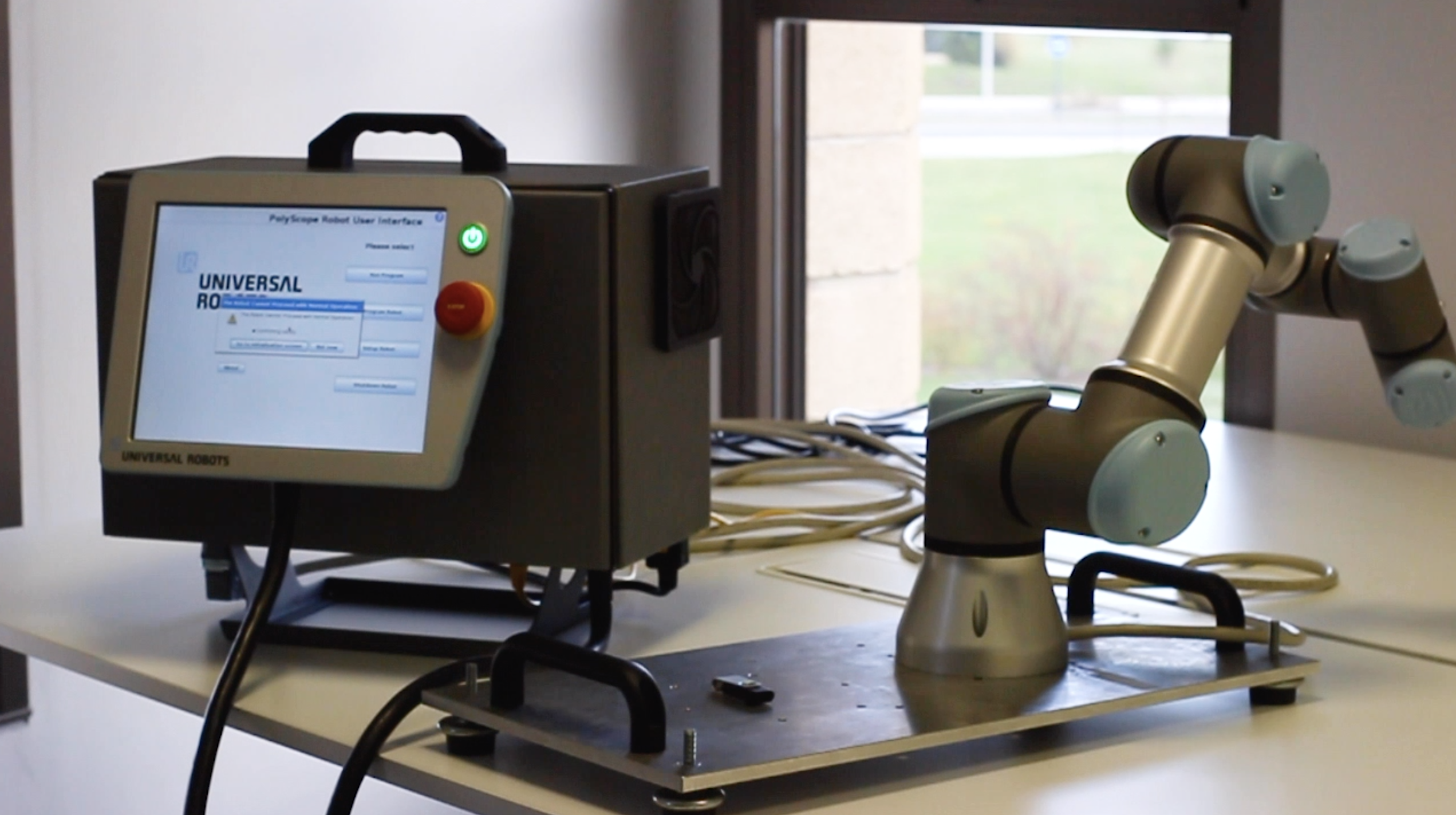
The authors discussed on all the above and coherently, decided to select what arguably is the most popular collaborative industrial robot manufacturer: Universal Robots. We select one of their best-selling robots, the UR3 and implement our PoC on it. Figure 1 shows a picture of our target together with the control box and teach pendant.
Before our work, Universal Robots had other groups assessing their insecurity. In 2017, Cerrudo and Apa reported
At the time of writing, our team knows yet of no security patch mitigating these vulnerabilities. Moreover, we performed a penetration testing assessment in the UR3 CB series robot confirming the still unpatched existence of several of the previously reported flaws. Furthermore, we found more than 300 new vulnerabilities of relevant severity according to robot-specific scoring mechanisms
The following subsection elaborates on how Akerbeltz acts on our UR3 CB series.
2.2 Ransomware’s flow
Cyber intrusion
Initial infection gets realised by exploiting unpatched vulnerabilities in the robot. Akerbeltz’s initial cyber intrusion is implemented exploiting these well known vulnerabilities and deployed via one of the following two attack vectors:
-
physical USB ports in the teach pendant: Exploiting CVE-2019-19626
Remains confidential for responsible disclosure reasons at the time of writing an attacker can execute malicious code with root privileges by simply connecting an external USB stick. This attack vector is likely the easiest to implement given the exposure of the teach pendant in most UR3 robots. Moreover, the same attack vector applies not only in the teach pendant but also in the control box which exposes internal USB ports that can be accessed with standard mechanical fixations. -
remote access via adjacent networks: RVD#672 (CVE-2018-10633) permits an adjacent network attacker to easily ssh into the control box. Alternatively, RVD#6 allows an adjacent attacker to exploit a stack-based buffer overflow in the UR3 ModBus TCP service, and execute commands as root equally fulfilling the cyber intrusion. Akerbeltz can be configured to exploit these flaws and take action over industrial LANs.
Lateral movement
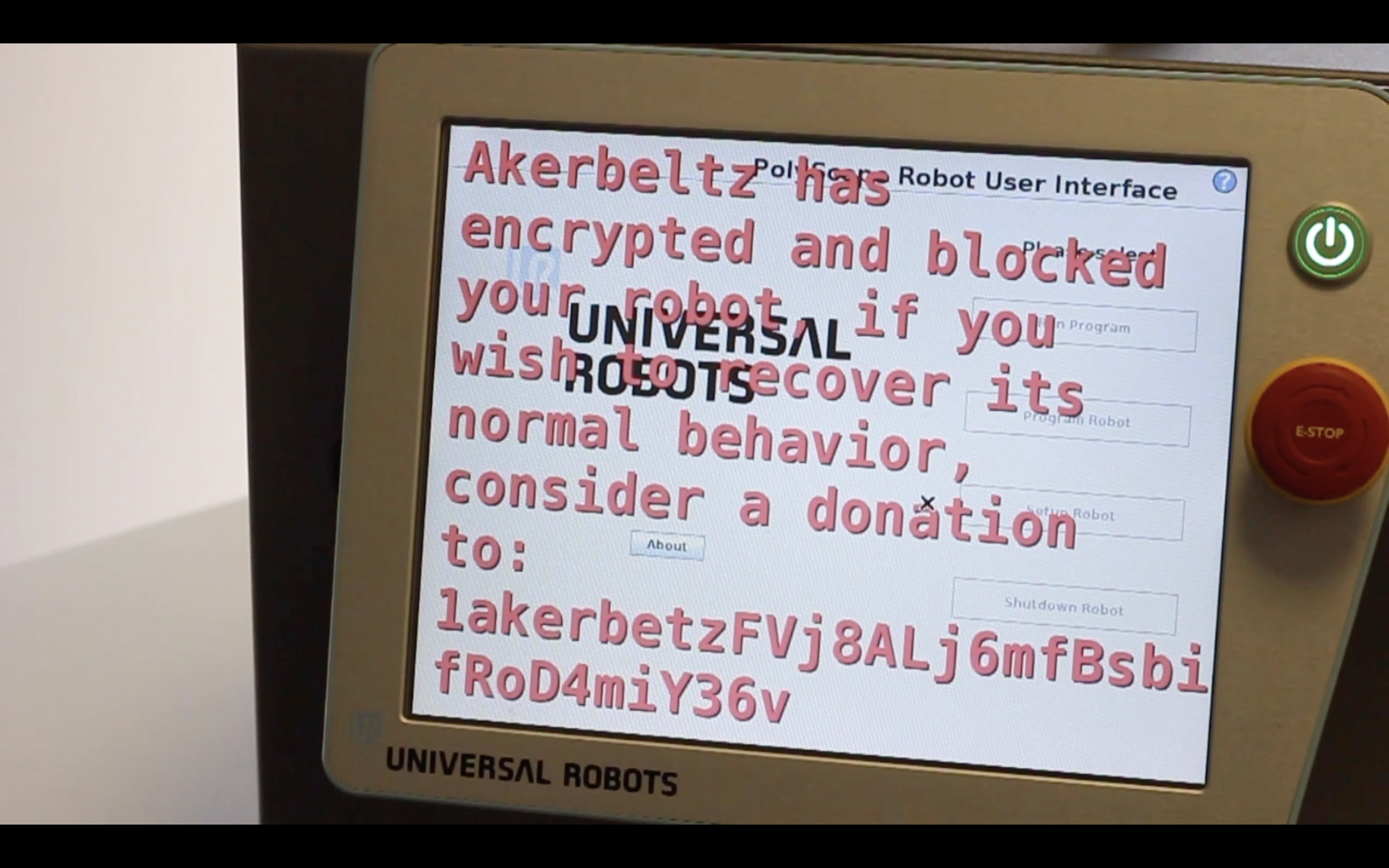
Since the cyber-intrusion allowed to obtain root privileges in the control box, no privilege escalation phase is necessary within Akerbeltz. The ”open” architecture of the robot facilitates lateral movement to other sub-devices within the robot. We briefly explored such setup and found that it is trivial to access the robot user interface, the PolyScope. Figure 2 shows a preview of the ransomware’s message in the teach pendant:
The UR3 lack of security allows for additional lateral movement. Both the BIOS of the robot controller and the safety PLC are easily accessible and exposed. While it remains beyond the scope of our study, we argue that targeting any of these systems (or both together) will likely lead to malware that could damage the robot to a point of no return and would likely be matter of future security research.
Control
-
Locking: In our PoC, our team was able to lock the whole system while displaying a message (refer to Figure 1) after booting, using previously mentioned CVEs, we managed to access the control box, acquire root privileges, disable the default safety configuration and change the default user and password. We also identified and disabled several open ports used to control the robot from the outside, blocking other mechanisms to reestablish normal operation. Our work with Akerbeltz finalized by performing some minor and non-exhaustive hardening, meant to avoid users to unlock the system.
-
Encrypting: After identifying most of the critical files used for the control of the robot, we located previous programs and IP deployed within the control box. These files are encrypted using the local pgp binary in combination with a series of robot-specific identifiers.
2.3 Discussion
In an attempt to responsibly disclose and mitigate the existing flaws, we generated a series of reports for selected vulnerabilities and approached the manufacturer by e-mail. To this date, no formal answer with intention to establish discussions on security has been received. In a second attempt, making use of well established and de facto approaches in security, we filed for a CVE identifier in one of the new discovered vulnerabilities. At the time of writing, no formal communication has been established via this channel either.
In a third attempt, the PoC attack was disclosed to Universal Robots directly, in a public robotics industrial conference, the ROS-Industrial Conference in Europe (Stuttgart, December 2019). While maintaining the vulnerabilities undisclosed, we publicly presented
The deployment of Akerbeltz in a UR3 via the physical attack vector has been recorded and made available at https://youtu.be/VF7fcV5j1t0 arguing that by making this public and available we finally call to a reaction of this particular vendor or its associated value chain.
Last but not least, our final discussion point is that these kind of targeted attacks have the potential to spread rapidly and across the use cases in which the Universal Robots CB-series are deployed. Given the low complexity of the attack, the easiness of programming on top of Universal Robots programming environment and the relative high cost of the assets involved, a series of attacks on this taxonomy are foreseen.
3 Conclusions
The current insecurity status in robotics allows for malware to be created easily and rapidly by simply evaluating known vulnerabilities. These pieces of malware could be used and exploited by malicious actors to gain economic profits via extorsion. In this paper we presented Akerbeltz, a piece of ransomware that locks and encrypts industrial collaborative robots from Universal Robots. After the targeted attack, the result is rendering the industrial robot totally useless, losing IP within the robot and potentially leading to economical losses and human or environmental damages. We described and prototyped Akerbeltz for the UR3 CB series robot which could be introduced following physical or network based attacks on zero-day vulnerabilities.
At the time of writing, Universal Robots has yet to answer our vulnerability reports, which in some cases provide the manufacturer relevant insights on how to mitigate the most relevant flaws exploited by the attack. As a particular example, for the physical attack vector we exploited in Akerbeltz, a possible mitigation involves the validation and sanitization of specific files as well as the implementation of Discretionary Access Control (DAC) model by providing Mandatory Access Control (MAC) within the control box. This will limit the programs’ capabilities with per-program profiles (e.g. via AppArmor).
When asked directly, face to face, representatives of the vendor, they indicated once again that their robot ”is designed to be open” or that we are ”disabling features” and therefore, ”it’s just normal”. We would like to express our strong concern for a reiterated lack of security actions. While our team did not explore malicious attacks or their profitability on the robot any further, we argue that a more aggressive individual or group, with bad intentions, might easily come up with some sort of ”self-destructing” malware (by disabling safety and repeatedly crossing the boundaries of the kinematics model and hitting itself) or worse, a ”human or environment damaging” one, or any other kind of creative exploits on top of the vulnerabilities exploited by Akerbeltz.
The lack of communication from the vendor’s perspective makes us guess that, at best, there is security by obscurity around Universal Robots. Once again as we did in the past, we argue against this and advocate for a proactive interaction of robot manufacturers with security researchers.
Future work on our side will involve the extension of Akerbeltz and the development of RIS (Robot Immune System), an ad-hoc intrusion detection system, available for use in Universal Robots, that further monitors on top of vulnerabilities and prevents existing flaws to be exploited.
4Acknowledgment
The authors would like to thank Laura Alzola Kirschgens for her support with ethics and proofreading the content. This action was partially supported by the regional Basque Autonomous Government’s SPRI agency for the support within HAZITEK funding scheme (ZL-2019/00439) and ZABALDU internationalization actions (ZAB-00014-2019). Special thanks to the Basque Cyber Security Centre BCSC for the support in actions fostering awareness in robot cyber security. Last but not least, authors are grateful to the local administration Diputación Foral de Álava for the support to entrepreneurship in innovation actions (EMPREM-2019/00002).